- Meet The Team
- •
Meet The Team: Nikola
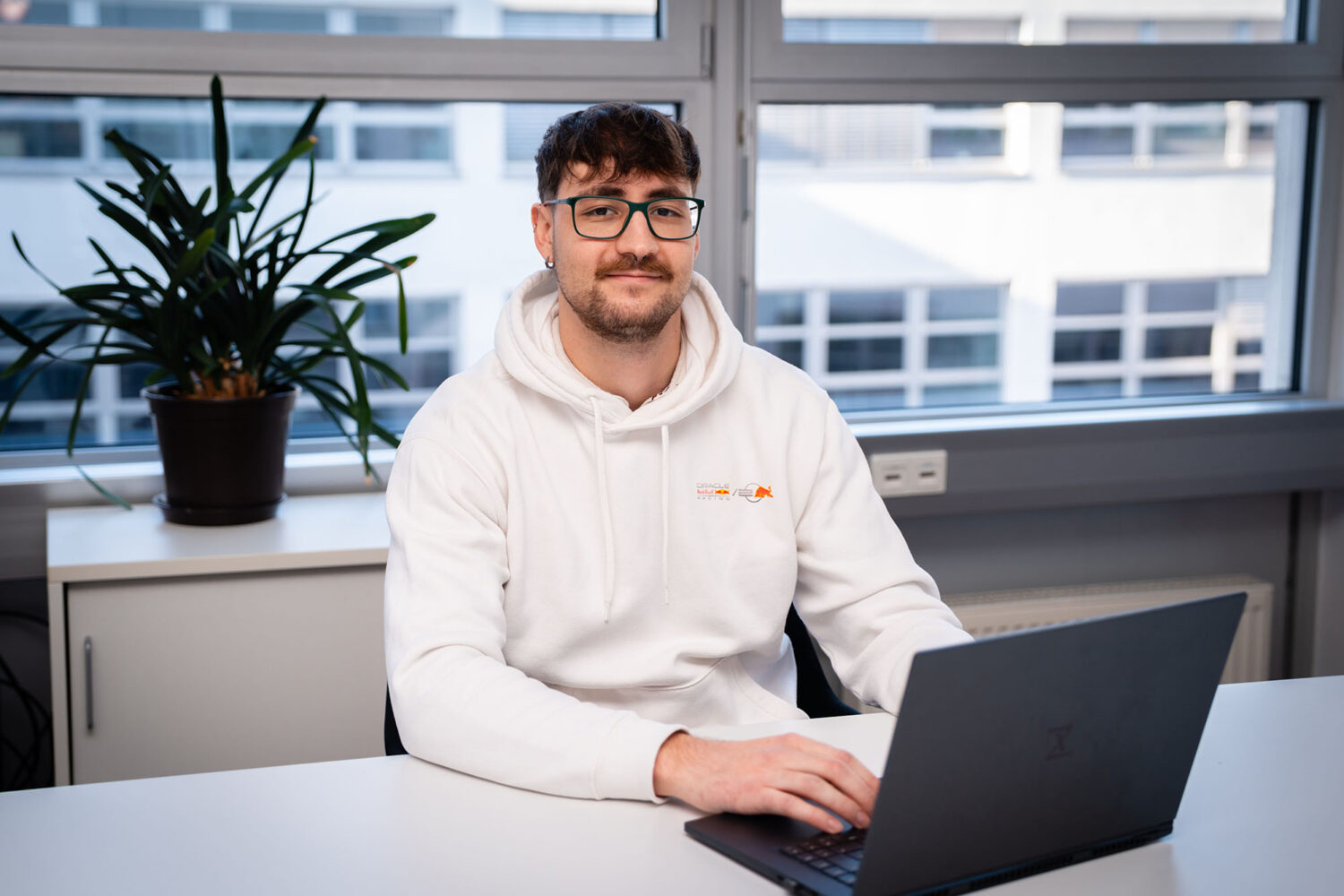
Nikola | AI Engineer
Please introduce yourself briefly: Who are you and how did you come to iSYS?
My name is Nikola. I studied Computer Science, specialising in Games Engineering – I completed my Master’s degree in April. I’ve been working in IT since 2017. I joined iSYS because I wanted to work on technically diverse software projects – and that’s exactly the path I’ve followed here: from developing mobile apps for logistics, through full-stack web development, to my current role in the field of artificial intelligence.
What are your tasks at iSYS?
I work as an AI Engineer and Full-Stack Developer and am currently working on two AI projects.
One of these is our in-house platform, ‘AI-Hub’, which enables staff to work with LLM-based chatbots – including access to the company’s own knowledge base. Technically, I cover the entire stack: React front-end, Spring Boot microservices on the back-end, authentication and role-based access control via Keycloak, plus the containerised infrastructure with Docker/Podman and the GitLab CI/CD pipelines. One key focus is retrieval-augmented generation: preparing content from Confluence or GitLab in such a way that an LLM can work with it reliably – from chunking strategies and embedding models, through vector search, to the integration of external systems via MCP.
The second project is the AI Tender Assistant, and this is the more technically interesting of the two. It involves automatically generating tenders from extensive tender documents. The specifications are often received as highly unstructured documents and contain items that have to be manually translated into specific products from a catalogue – a process that has, until now, been extremely time-consuming.
How did you go about implementing the AI tender assistant from a technical point of view?
We started with a FastAPI backend, PostgreSQL, a Next.js frontend and Qdrant as the vector database. The project is now running in a second, completely rebuilt version – we learnt a great deal from the first one about where the real difficulties lie, and were able to redesign the architecture accordingly.
At the heart of it all is the retrieval architecture: we use historical, human-generated data provided by the respective customer as few-shot examples for product matching.. This means the model not only considers the individual tender item, but also how comparable items were actually categorised in the past.
And that’s just where the interesting engineering challenges begin. German technical terminology poses a real challenge for standard embedding models – abbreviations and full forms of the same component should be semantically close to one another, but depending on the model, this isn’t always the case. Added to this is the question of how to design the feedback loop properly: if corrected quotes flow back into the retrieval pool, a single error can compound over time. To make matters more difficult, each customer has their own pool — so we cannot collect data across projects, but must instead arrive at reliable results even with small sample sizes. And above all, it is ultimately a human who is responsible for the quote – so the system must make it clear why it is suggesting a particular match, rather than simply spitting out a result.
What excites you most about your job?
The breadth of technology. At iSYS, I’ve already worked on Flutter apps, the modernisation of legacy Java systems and modern React interfaces. At the moment, I find generative AI particularly exciting because the field is evolving so rapidly: what was best practice six months ago is now outdated. Added to this is the appeal of the fact that, with LLM systems, you’re not just building software in the traditional sense, but have to do a lot of evaluation and experimentation – a feature isn’t finished until the quality of the responses is right, not when the code compiles. You notice this very clearly with the tender assistant: the architecture was in place relatively quickly; the real work was fine-tuning the retrieval and prompting.
What can new team members expect when they join iSYS?
It’s a very supportive environment. You’re not left to your own devices here – I’ve had first-hand experience of training new colleagues and helping them settle in. We often use agile methods such as Scrum or Kanban, which makes it easier to get started on projects. What’s more, the team is keen to share knowledge.
What do you do in your free time?
In keeping with my degree in games engineering, I actually still quite enjoy gaming, even though I don’t get round to it as often as I used to. Otherwise, I like doing sport to balance out working at the computer and I meet up with friends a lot.
And finally: would you like to share a playlist with us?