- Events
- •
From Idea to Solution: A Look Back at the iSYS Hackathon 2026
Two Teams, One Challenge: AI Meets Real-World Application
The focus was on a practical use case from UWS. It relies on measurement data from the WaterBoy: Specialized companies use this measuring device to test the quality of heating water, and the values are transmitted directly to the UWS Cloud via the WaterBoy app. In the future, this data will not only be stored and displayed there, but also analyzed using AI. Based on parameters such as conductivity, pH, and temperature, as well as the system’s technical specifications, the goal is to provide a clear assessment of the system’s condition, including specific recommendations for action.
This presented the teams with a twofold challenge. In addition to the technical implementation, they had to quickly familiarize themselves with a complex field of expertise: What do the measurement values reveal about a heating system, what are the standard values, and what measures are effective? That is precisely one of our core strengths as custom software developers: quickly getting to grips with our clients’ business needs. Because that’s the only way to create solutions with real added value. Both teams worked on the same task, each with their own ideas and approaches.
AI on Two Levels
At the hackathon, AI was not only a topic but also a tool. An AI-driven software engineering approach was employed: AI agents handled large portions of the programming work, while the teams provided direction and business logic and verified the results. The approach was holistic—from the UWS Cloud all the way to the WaterBoy app, that is, to the point where measurements are taken on-site.
These solutions are more than just chatbots. They specifically combine three components: Data processing brings together measurement values and plant data. A rule-based analysis checks them against reference values in a transparent manner. And generative AI uses this information to formulate clear assessments and recommendations. In this way, the solutions combine the reliability of clear rules with the clarity of generative AI.
The Grand Finale: Showcases and Valuable Insights
On October 16, both teams presented their showcases in Munich. The jury brought together perspectives from industry, the energy sector, and academia, supplemented by two experts from UWS, the organization that developed the use case:
- Hans Bernhofer (Head of Logistics Europe @ BSH Home Appliances Group)
- Lennard Born (Projektmanager IT mit Schwerpunkt KI & Prozessoptimierung @ Hama GmbH & Co KG)
- Prof. Dr.-Ing. Marcin Hinz (Professor for Artificial Intelligence @ Hochschule München)
- Prof. Dr. Andreas Humpe (Professor in Mathematics and Finance @ Hochschule München)
- Marvin Landwehr (Product Manager @ UWS Technologie GmbH / Aalberts hydronic flow control)
- Mario Milkovic (Head of R&D @ UWS Technologie GmbH / Aalberts hydronic flow control)
- Christoph Müller (Leiter IT @ Stadtwerke Pfaffenhofen)
- Heiko Schaper (Projektleiter ‘Digitale Transformation’ und Solution Architect @ Stadtwerke Pfaffenhofen)
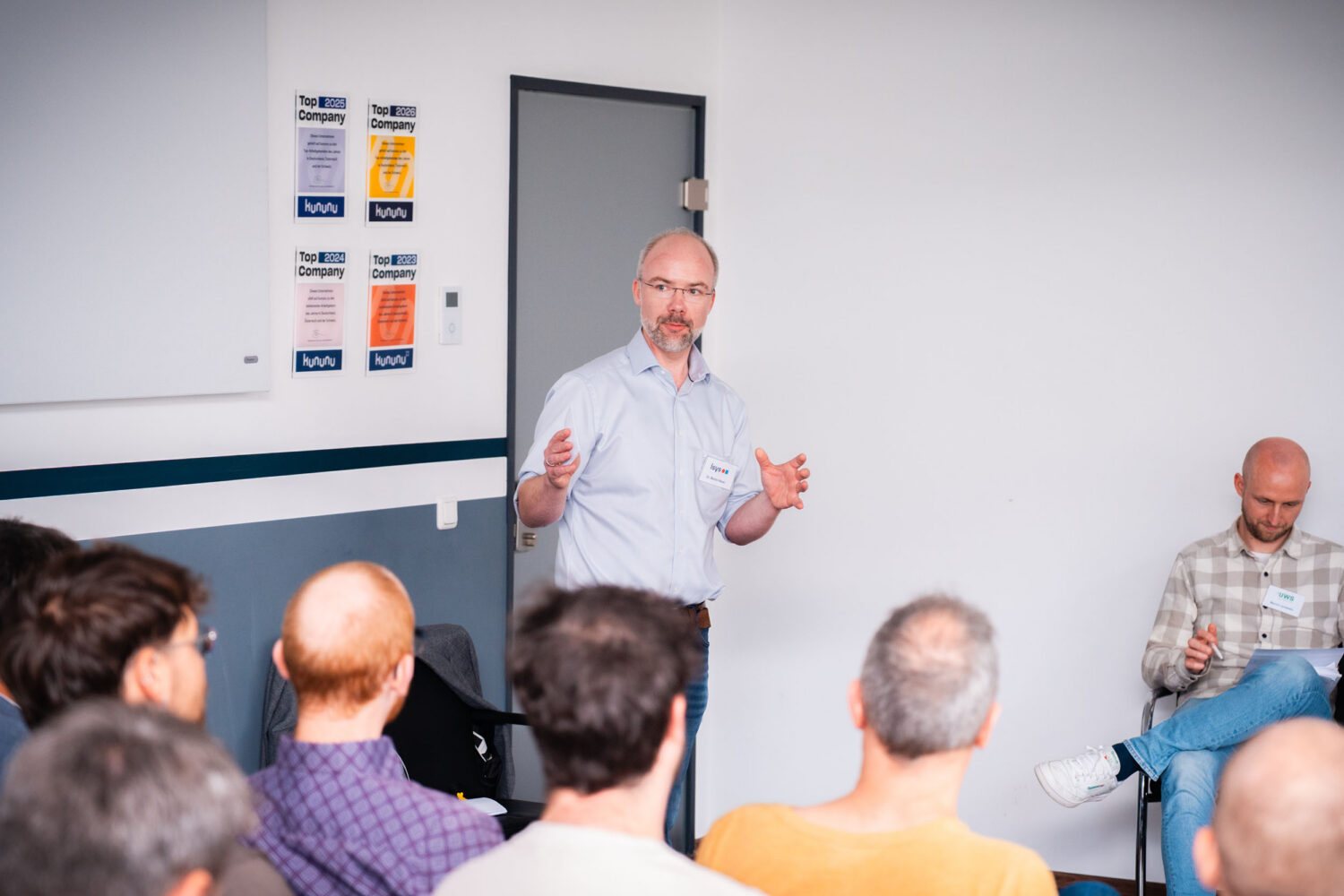
Dr. Martin Häusl (pictured above) moderated the feedback session. The discussion focused primarily on user value, feasibility, and innovation potential. The jury unanimously highlighted two things: how quickly the teams had familiarized themselves with the complex technical subject matter, and the amazing results they had achieved in just one week.
Exchange, Networking, and a Big Thank You
Just as important as the results was the sense of community. During the networking session that followed, participants discussed technologies, real-world experiences, and potential applications in a relaxed atmosphere. The hackathon demonstrated once again how much can be achieved when you create space for new ideas, experiment together, and learn from one another.
A big thank you to our two hackathon teams, to UWS for the exciting use case, and to all the jury members for their dedication, feedback, and the many great conversations!